
When your subscription app breaks Local Pickup and Delivery
 shopify
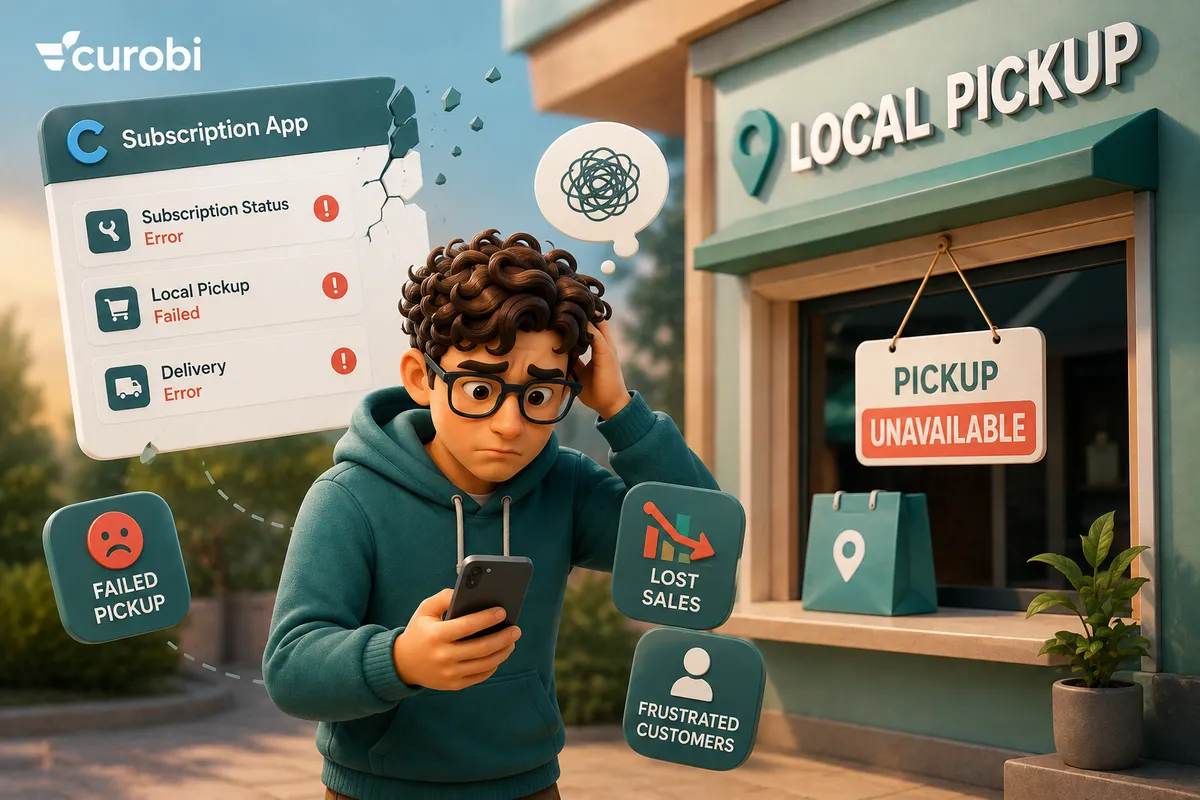
Plenty of roasters aren’t purely mail-order. They run a café, a roastery storefront, or a delivery van around town — and a real slice of their subscribers would rather pick the bag up on their morning commute than wait for a courier. Shopify supports that natively with Local Pickup and Local Delivery. The problem is that some subscription apps quietly turn those options off.
How a subscription app disables pickup
The failure is structural, not a bug. Older subscription apps don’t use Shopify’s own checkout — they insert a third-party billing page or redirect into the flow so they can manage the recurring charge themselves. The moment the checkout is no longer Shopify’s, Shopify’s own delivery features stop being in control of it. The concrete example merchants have run into: even after moving to Shopify’s native checkout, one major app’s checkout integration still doesn’t work with Local Pickup and Local Delivery. For a roaster whose subscribers collect at the shop, that’s not a minor gap — it’s a dealbreaker that silently removes the fulfilment method a chunk of their customers prefer.
And it’s getting more fragile, not less. Shopify’s ongoing checkout changes — the move to checkout extensibility and the broader checkout-system transition — keep reshaping how apps are allowed to touch the checkout, and every bolt-on billing layer is another thing that can break when the platform shifts underneath it.
Why native rails don’t have this problem
An app built on Shopify’s own Subscription Contracts and native checkout doesn’t insert its own checkout at all. The subscription is created at Shopify’s real checkout and then mirrored into the app for management — so the app is never standing between the customer and Shopify’s delivery logic. There’s no third-party billing page for Local Pickup and Local Delivery to be incompatible with, because the checkout the customer sees is Shopify’s, with Shopify’s own fulfilment options intact.
That’s the general principle worth checking before you commit to any subscription app: does it run on Shopify’s native checkout, or does it redirect to its own? The answer determines whether the rest of Shopify’s checkout features keep working or quietly start failing.
Where Curobi lands
Curobi runs on Shopify Subscription Contracts and Shopify’s native checkout — there’s no third-party billing processor or redirect, and Curobi never touches or stores card data. Subscriptions are created at Shopify’s checkout and mirrored into Curobi for management, so the checkout your customers pass through is Shopify’s own. If local fulfilment matters to your roastery, that native-checkout foundation is the thing that keeps it from breaking. For the wider “does it use native checkout” question and everything else that hangs off it, see when you outgrow Shopify’s native subscriptions.
The takeaway
If you run a café or deliver locally, the way a subscription app handles checkout isn’t a technicality — it decides whether your subscribers can still pick up their coffee at the shop. Apps that redirect to their own billing page can disable Local Pickup and Local Delivery; apps on Shopify’s native checkout don’t, because they never take the checkout over in the first place. Before you install anything, ask where the checkout actually happens.